Insights Our Blog
The Economic Impact of Cyber Incidents 2025
Alltime Technologies Limited, Cyber Security Managed Services and Consultancy provider 310
310
310
310

 1200
627
310
310
1200
627
310
310

Written by
Simon bring more than 20 years of experience in cloud architecture, networking, infrastructure design. He holds a BSC in Physics from Lancaster University and a postgraduate Master's programme in Cloud Computing from Caltech CMTE as well as holds the globally respected CISSP certification. His academic and professional background spans Microsoft Azure, Amazon Web Services (AWS) and Google Cloud Platform (GCP), underpinned by a strong focus on AI, DevOps and Automation.
This report outlines the financial severity of cyber incidents affecting UK organisations. Using recognised modelling from Cyentia Institute’s IRIS dataset, KPMG summarised the economic impact by organisation size and sector. The UK Government later republished these findings, recognising the significance of the underlying analysis.
The latest independent research underscores that cyber-risk is not just a technology fault line – it is a business critical threat. According to the summary published by the National Cyber Security Centre (NCSC) on behalf of the UK Government, the average cost of a significant cyber incident for a UK business is almost £195,000.
When this cost is scaled across the national economy the annual estimate reaches approximately £14.7 billion, equivalent to about 0.5 % of UK GDP.
The term “significant cyber incident” is defined in the modelling as a successful event that imposes direct costs of at least £500.
Importantly, the data also show that the highest average incident costs are clustered in sectors such as information (£337,000), manufacturing (£330,000), and management services (£334,000).
This establishes several key takeaways:
Representative values based on Nationwide’s House Price Index (HPI June 2025) include

The next chart places the average cost of a significant cyber incident (~£195,000) in context by comparing it with typical UK home-prices. The cyber-impact figure is taken from the KPMG (2025) modelling study as summarised by the Department for Science, Innovation & Technology (DSIT) in its ‘Independent research on the economic impact of cyber attacks on the UK’:
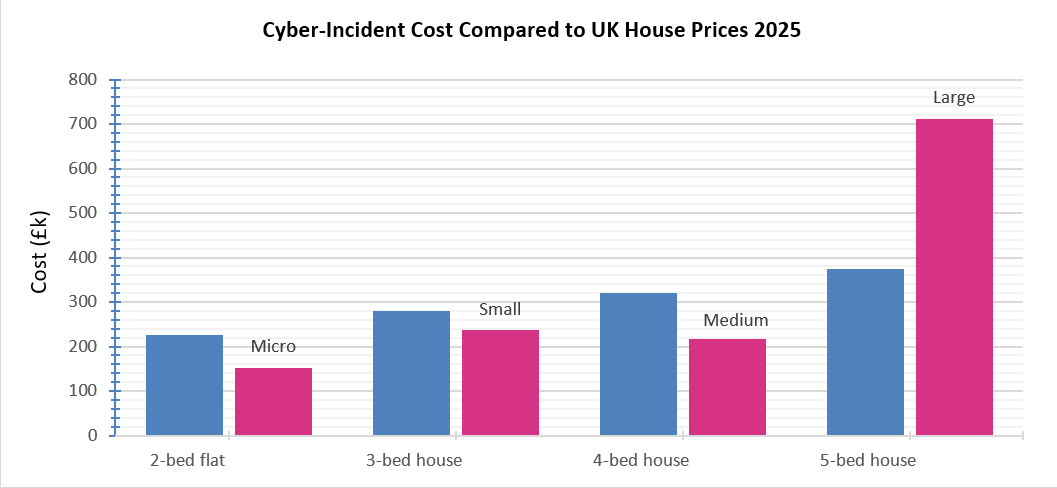
The data presented originates from the Cyentia Institute’s Information Risk Insights Study (IRIS).
KPMG’s study derived the IRIS dataset combined with UK survey data (e.g., the Cyber Security Breaches Survey). Reinforcing the credibility of the figures while acknowledging all assumptions involved. KPMG used this dataset to model sector-by-sector and size-specific estimated economic impacts.
The UK Government subsequently published a summary referencing KPMG’s work, validating the importance of this analysis.
For small and micro businesses, the financial shock from an incident can exceed operational resilience. Aligning cyber practices with business value protects long-term stability and maintains customer trust.
Alltime Technologies provides strategic, operational, and technical support to help organisations reduce cyber risk. As an IASME Cyber Essentials Certification Body recognised by the NCSC, our qualified consultants guide organisations through practical, robust security improvements, including policy design, security controls, readiness assessment, and operational uplift.
Give us a call, perhaps we can help?
Sign up for our newsletter and get the latest cyber security industry news and views direct to your inbox.
Contact us today to schedule a vulnerability scan and take the first step toward a stronger security posture.
Contact us